Saturday, March 16, 2013

Relationship Reflection


Relationships/partnerships play a huge role in my life and have since I was little. They have helped me grow and evolve and I have learned so much from those that I have relationships/partnerships with. These positive relationships help physical, spiritual, and emotional health. Through my relationships I have been able to deepen and expand my experiences of love and meaning. For me I enjoy connecting with others and building lasting and life long relationships. It is important for me to have people that I know are always there for me and vice versa. Below are several people with whom I currently have positive relationships/partnerships with.

The first relationship is the relationship I have with my mother. Throughout my life she has been my support system. She was the one that nurtured and protected me. My mother has always encouraged me and supported my wishes and dreams. She is there for me when I need and can always pick me up when I'm down. Though our relationship has not always been perfect, we have always remained close. 
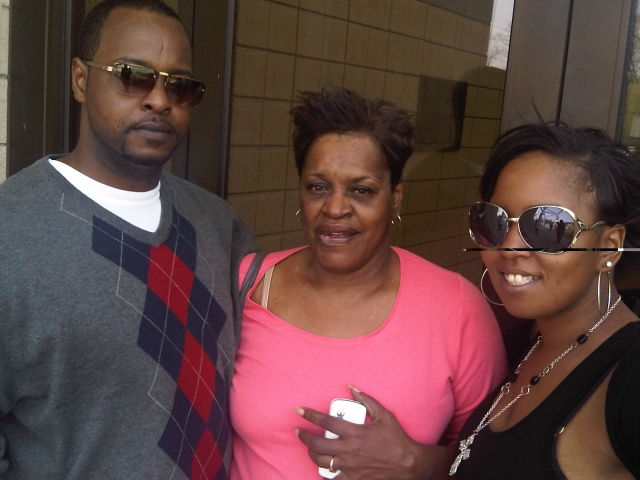
My brother, mother, and myself.
The next relationship that is important to me is the relationship I have with my dad. Growing up he wasn't always around and not because he didn't want to be. My father drives trucks and has since before I was born. As a little girl he tried to maintain a positive relationship between the two of us by frequent calls and visits. For me that played a huge role is us developing a lasting and positive relationship. When I got older, my father moved from Houston, TX to Atlanta, Ga. He also began to take trucking routes that were local and allowed him to be home one the weekend. Our relationship has become one that is important to my life and growth. I can talk to my dad about anything and he is always there for me. We talk frequently and have our weekend daddy-daughter days. My relationship with him has taught me a lot about myself. 
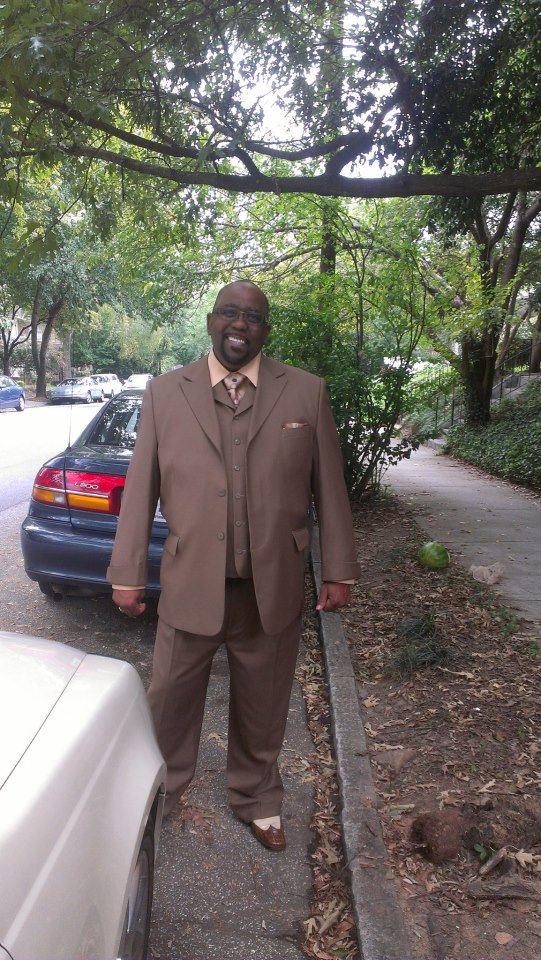
My father
Another relationship/partnership that is influential to my life is the relationship I have with my boyfriend Gary. I have known him since the 7th grade and he has been my best friend since then. Growing up he was always there for me. He protected me and was a shoulder I could lean on. With him, I could always be myself. After we graduated high school, I went away to school. Even then he still came to visit and we talked often. During my last few years of college we stopped talking as much and didn't see each other often. It was until I graduated from college and moved back home that we reconnected. Once we reconnected, it was like that friendship that we had never went away. That friendship has now grown to something deeper. He is not only my best friend but he is my partner and I love him dearly. He understands me and knows everything about me. He supports me and encourages me no matter what. 

Me and my boyfriend Gary


My relationship with my best friend Milli is also one that I can say has a positive influence on my life. The relationship between Milli didn't start off as us being friends. We met in college through a mutual friend and because of certain circumstances, we did not like or care for each other. Overtime we began to bond and become friends. Since then our friendship has grown. I know consider her to be my best friend and my sister. She has always been there for me and she always helps me not matter what I'm going through. Milli is there when I need someone to talk to or just tell how my day was. She is an important person in my life and I couldn't imagine it any other way.
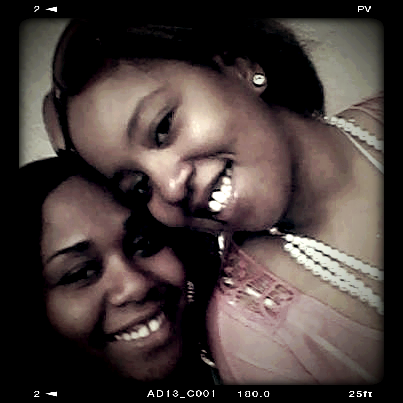
Me and Milli
For me communication plays a huge role in any relationship. I also believe honesty and loyalty play a role in developing and maintain any relationship. I struggle with trusting people sometimes so for me its hard to develop relationships. The relationships and partnerships that I have are ones that have been through a lot and overcame it all. They have proven to be key factors in my life and learning. At times some of my relationships face challenges due to distance but through that I have learned that no matter how far you are from someone if it is a true relationship and both parties feel the same way about each other and their relationship then it will last a life time. My relationships have shown me that I need to be able to communicate with those I am around and that helps build a positive relationship.

Saturday, March 2, 2013

My Favorite Quote

"Children are the world's most valuable resource and its best hope for the future"
-John Fitzgerald Kennedy

To me this quote is so true and as an educator helps me see how my job plays such a important role on a child's growth and development. The lessons and skills we teach children during their early childhood years helps shape the kind of adult and person they will be when they grow up. It is important that we teach children life long lessons so that they are able to have a successful future. The children that we teach now are our future and its important that we prepare them as we teach them. Children are valuable and we should teach them and treat them with that in mind.


Saturday, February 16, 2013

Assessments


I think in today’s society too much pressure is being put on the children when it comes to the assessments they are being given. Some of the assessments being used are not a true measure of what a child knows. Think about standardized test and the questions you may see on those. Most of the questions are based on how well you can memorize information instead of being about how well a child’s problem solving skills are. I think assessments should show growth and not just measure what a child knows at a certain time. Think about when you use to study for test, how often did you remember the information after finishing the test? Also consider that some people are not good test takers. Some people panic when taking a test and in the end do not do their best.  I think when measuring or assessing a child’s knowledge we could look at everything the child has done as a whole.

Assessments in England
I decided to take a look at how children in England are assessed. When talking about how children are assessed in England, I must first discuss how the education system works.  The basic curriculum includes something known as the national curriculum. These are subject and standards taught so that children in primary and secondary schools can learn the same thing. Under the national curriculum, children are required to reach a certain standard in each subject. The national curriculum is divided into blocks of years called Key Stages.  At the end of each key stage, a child’s teacher will formally assess their performance to measure the child’s progress. For each subject there’s something known as a ‘program of study, which describes what children should learn. There is also an ‘attainment target’ - usually split into 8 levels for each subject.  Between the ages of 7 and 11, a child will complete 3 assessments.  They complete a teacher assessment over English, math, and science and have to be in their second year in all subjects by the age of 7.This occurs during Key Stage 1(KS1). Between the ages of 10 and 11, a child will take a national test and a teacher assessment also in English, math and science. At this time the child should be at a level 4. All of this occurs during Key Stage 2(KS2).
Now we get to the actual assessment. During Key Stage 1, children will complete tasks and test over several subjects. These subjects are reading, writing, speaking and listening, math, and science. The teacher will use a child’s work to determine what level the child is at in each subject. The teacher will also consider the child’s spoken work and homework when determining the level. During Key Stage 2, the child will take a test that covers English reading, English grammar, punctuation, spelling, and math. It also includes mental arithmetic. If a child demonstrates higher achievement the head teacher may decide to have them take extra test to determine true level. At the end of key stage 2, the teacher will give a report on a child’s progression in English, math, and science.
Reference:
The National Curriculum. (2013). Retrieved February 16, 2013. https://www.gov.uk/national-curriculum/overview

Saturday, February 2, 2013

Stressors


For this week’s blog, I talked with Ms. Lauren, a co-worker of mine, about the stressors she encountered as a child. She grew up during the time when blacks and whites were treated different and attended different schools. During her middle school years, the area in which she lived decided to combine the black and white schools. Children from the black neighborhoods began being bused to the white schools, which were 45 minutes away. Her first week of school was hectic; teachers did not show up just because they did not want to teach black children. Ms. Lauren remembers their being constant fighting not only between the whites and blacks but among rival black neighborhoods. This time was hard for her growing up, she could not understand why the teachers did not want to teach her and the children like her.  Going into high school, things did not get better. There was a constant battle between the white students and the black students.  Mrs. Lauren coped with the situation by joining school organizations and tired to make a difference. She found people that held the same beliefs as she did.  Even though it was a tough time in her life, she still managed to stay strong and pursue the things she wanted not matter what others had to say.

I decided to look at the stressor(s) that impact the development of children in India. The situation in India is fairly dismal and sometimes over looked. The immediate causes of underdevelopment in India relate to inadequate feeding practices, poor prevention and management of illness, and inadequate care. The stressors are primarily caused by the low status of Indian women, poverty, and a vicious cycle of low-weight moms having too many children too early and too close together. More than one in five babies in India (22%) is born with low birth weight, putting them at risk of under nutrition and illness even before birth (Blake, Chand, & Gupta) . More than half of under-threes are deprived of full immunization. Infants do not receive the social and emotional care they need.  A high number of parents work full time from soon after birth, and young siblings often end up looking after children. These are just some of the stressors that children in India encounter and not all children experience these stressors. There are now ECE programs that aid in fighting against these issues and fighting to provide children with the right conditions in which they grow in. Ensuring children get the proper care need to lay down the foundations for a good life. There are even well-established interventions that can help improve child development—from breastfeeding counseling to community based health services to the fortification of staple foods. Early Childhood Development programs have be started to address several components of the problem, typically through a combination of daycare and community-based services.


Reference
Blake, S., Chand, T., & Gupta, G. (2009) Starting Strong: Early childhood development in India.    
New Philanthropy Capital. Retrieved from http://www.forces.org.in/publications/Startingstrongfinal.pdf

Saturday, January 19, 2013

Nutrition and Malnutrition

Before you can understand how nutrition/malnutrition impacts the development of a child, you must first understand nutrition and malnutrition. Nutrition refers to the consumption of materials necessary to support a healthy life. Malnutrition is the condition that comes from the lack of nutrients in diet, too high of an intake or the wrong proportions are being consumed. Both nutrition and malnutrition play a huge role in the development of children. Proper nutrition provides children with the energy and nutrients needed to meet their physical and mental potential. The lack of nutrients present in a child’s diet is damaging because their bodies are constantly changing, going through different stages of development.
Whether we realize it or not, a child’s diet affects them on a daily basis. Students that get the proper nutrients and the proper amount are providing their bodies with the fuel needed to grow their minds and body. Children with a healthy diet tend to be more focused and have a longer attention span. Children that are malnourished experience fatigue, low energy, and are more perceptible to infection and sickness.

Malnutrition in Central America
Malnutrition has never been a huge problem in Central America until now. Recently, chronic malnutrition has been as prevalent in Central America as it is in Africa and South Asia. In Guatemala, half of all children under five years are chronically malnourished.  In El Salvador, Honduras and Nicaragua, one out of every three children under five years is affected.  There has been no improvement in reducing malnutrition in these four countries for over a decade. Malnutrition in these countries is a direct reflection of increased poverty and has a negative effect on the economic growth. Children that live in poor and rural areas suffer more from malnutrition.


Reference:
Pitts, N.(2012) Central America. Malnutrition and Poverty threaten to the region yet. Retrieved from http://www.jpic-jp.org/71-en.html

Saturday, January 12, 2013

The Child Birthing Experience

My personal experience with child birthing is limited. My knowledge of my own birth is limited and I haven't had the pleasure of giving birth. I have had one experience and that one still surprises me til this day. The one experience I have with child birthing happened when I was in college. It wasn't like it was a close friend, it actually was my boyfriend's (at the time) sister. It was kind of one of those situations where you want to be helpful but the awkwardness is kind of overwhelming. I can say the event was one to remember. I remember getting a phone call from my boyfriend saying his sister was going into labor and their was no one that could be their with her, so he asked me to go. My first reaction was pure shock because me and his sister weren't like the best of friends. When I arrived at the hospital, she was in the room and apparently had been in labor for a while. At this point they where monitoring the babies heart rate and trying to get the baby to change its position. I worried that their would be complications and I wasn't sure how to handle it, if their was. Eventually the babies position changed and they ended up inducing her labor. A few hours had passed before she started delivery.I could tell she was in so much pain. Finally, the baby arrived. They weighed him and I was able to take the first picture. While this experience started off awkward, it was a true learning experience. 
I think birth is a special and precious event that occurs. It plays a huge role in the development of the child. Things that happen during the pregnancy effects how the child grows. The chooses people make during prenatal development can have an everlasting effect on how a child learns, behaves, and interacts with others.

Ethiopia's View

Child birth in Ethiopia is different then that of the United States. When a woman is pregnant it is not talked about until she is showing. She is expected to continue working and doing chores until she gives birth. During the eighth month of pregnancy the woman goes and lives with her parents to prepare for the birth. Unlike most people in the United States, items are not purchased for the baby until its born. During the labor the expecting mother, along with family and friends drink coffee and burn incenses as a ritual. This is completely different then what happens here in the United States or at least from my one experienced. Surprisingly in this culture men are not involved in the delivery of their child. In our culture, the role of the husband (or father of child) during delivery is important to most couples. In the rural areas, midwives are used to assist in child birthing. My experience was  different from the child birthing experience of an Ethiopian woman. Different cultures have different views on the process of child birthing but also have many similarities. The main goal is to ensure a safe delivery for the mother and child.


Reference:
Molakign, A. (1996) Ethiopian cultural profile: Information about Ethiopian history, culture and  
           community with emphasis on health related issues. Retrieved from EthnoMed website: 
           http://ethnomed.org/culture/ethiopian/copy_of_ethiopian-cultural-profile 

Sunday, December 16, 2012

Reflection on the Code of Ethics

After reviewing the code of ethics, these are the three that stood out to me.
 
P-1.2—We shall care for and educate children in
positive emotional and social environments that are
cognitively stimulating and that support each child’s
culture, language, ethnicity, and family structure.
 
I-1.5—To create and maintain safe and healthy settings
that foster children’s social, emotional, cognitive, and
physical development and that respect their dignity
and their contributions.
It is important that children have a safe enviornment to learn in. As educators we have a duty to provide a learning enviroment that supports the children in all ways.
I-1.1—To be familiar with the knowledge base of early
childhood care and education and to stay informed
through continuing education and training.
As educators, it is also important that we continue to increase our knowlege. We should be informed of all issues that involve the early childhood profession.